The precision required in scientific measurements often demands a careful understanding of unit conversions, a task that forms the foundation of accurate data collection and communication in fields ranging from chemistry to medicine. Consider this: at the heart of this discipline lies the ability to work through the interplay between different measurement systems, ensuring that results are not only precise but also reliable. Among the most critical units in this realm are grams (g) and milligrams (mg), each serving distinct roles that must be mastered to avoid misinterpretation. Grams, with their scale encompassing a vast range from milligrams to kilograms, represent the macroscopic realm of matter, while milligrams, though smaller, still hold significance in contexts where minute quantities are key. The relationship between these units is not merely numerical but conceptual, rooted in the fundamental principles of measurement that govern how substances interact with the physical world. Understanding this connection is essential for professionals who rely on these units to describe phenomena accurately, whether in laboratory settings, clinical diagnostics, or industrial applications. The conversion between grams and milligrams, while seemingly straightforward, requires careful attention to avoid errors that could cascade into broader implications. This article walks through the intricacies of such conversions, exploring their practical applications, common pitfalls, and the importance of maintaining precision in scientific communication. By examining the underlying principles and real-world relevance, we uncover why mastering these transformations is not just a technical necessity but a cornerstone of effective scientific practice.
Not the most exciting part, but easily the most useful.
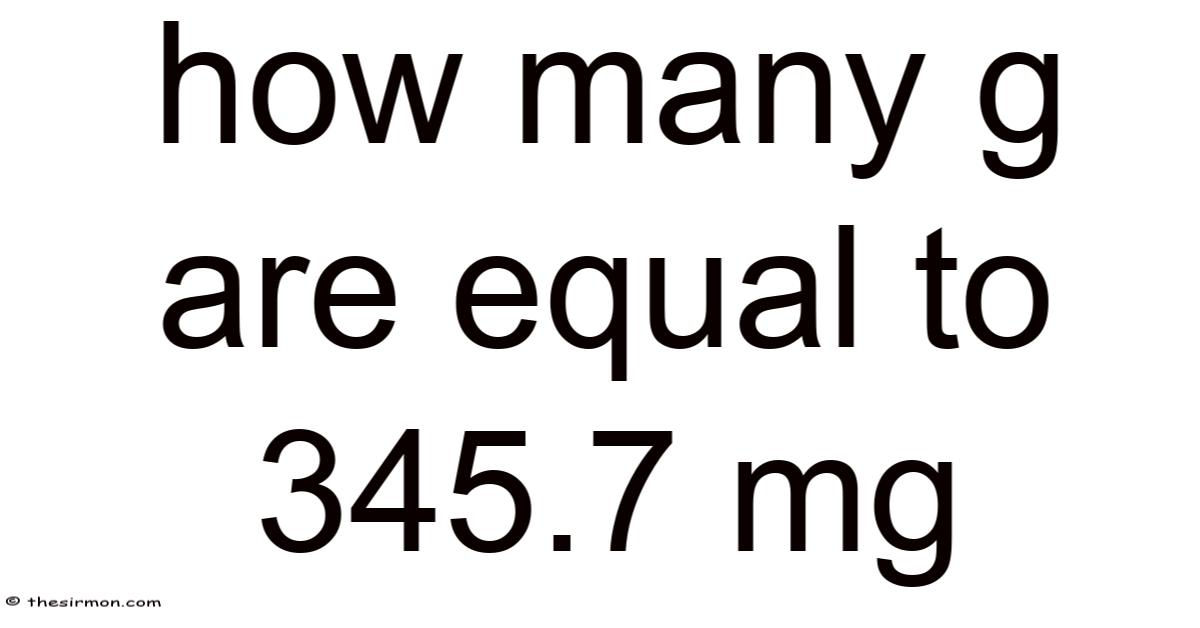
The distinction between grams and milligrams often arises from their differing scales of magnitude, yet their interplay reveals the structure of quantitative analysis. A gram, being one thousand times heavier than a milligram, serves as a bridge between the microscopic and macroscopic worlds. In everyday life, one might encounter situations where even a single milligram can make a substantial difference, such as in pharmaceutical formulations where precision dictates efficacy. Conversely, grams, though larger in magnitude, provide a broader context for understanding mass accumulation. Plus, this duality necessitates a nuanced approach when converting between the two units, particularly when dealing with values that straddle their thresholds. Here's a good example: considering that 1 gram equals 1000 milligrams, any value in grams must be scaled down by a factor of 1000 to attain equivalent milligrams, while vice versa. Such conversions are not trivial tasks that demand attention to detail, as even minor miscalculations can lead to significant discrepancies. In the context of the specific query at hand—transforming 345.7 milligrams into grams—it becomes evident that the process involves straightforward arithmetic, yet its importance extends beyond mere computation. In practice, the value 345. 7 mg, though seemingly small, represents a tangible quantity that, when converted, offers insights into its role within a larger framework. Consider this: this conversion serves as a gateway to deeper understanding, illustrating how small numerical adjustments can have cascading effects on the overall interpretation of data. On top of that, the process underscores the importance of unit consistency in reporting results, ensuring that all measurements align with established standards and that conclusions drawn are both valid and trustworthy. Beyond the immediate calculation, the act of converting units reinforces a mindset rooted in accuracy and attention to detail, qualities that are very important in disciplines where precision underpins success. Even so, whether analyzing chemical reactions, assessing drug dosages, or monitoring environmental pollutants, the ability to work through these conversions is a skill that enhances competence and confidence. It also highlights the interconnectedness of mathematical principles and practical applications, reminding practitioners that numbers are not abstract concepts but tools with real-world consequences. In this light, the conversion from 345.7 mg to grams becomes more than a mathematical exercise; it is an act of bridging disparate scales to achieve coherence and clarity in communication. This foundational skill, while seemingly simple, holds profound implications for its application across various domains, reinforcing its status as a vital component of scientific literacy.
The significance of this conversion extends beyond its technical aspect, influencing how information is perceived and utilized. In scientific reporting, for example, accurate unit conversions check that findings are presented consistently across different contexts, allowing for seamless integration into broader discussions. When data is misrepresented due to improper scaling, conclusions drawn from it may be flawed, leading to misguided decisions or wasted resources. Day to day, conversely, when conversions are handled meticulously, the integrity of the data remains intact, fostering trust among stakeholders. This reliability is particularly crucial in fields where errors can have cascading effects, such as in clinical settings where medication dosages must be precise to prevent adverse outcomes. But the process of converting 345. 7 mg into grams also invites reflection on the broader context in which this value is situated. Day to day, is this measurement part of a larger dataset? But how does it fit into existing models or theories? Understanding these relationships allows for informed interpretations that go beyond the numerical value itself. Additionally, the act of conversion often necessitates a reevaluation of other related measurements, prompting a more holistic approach to problem-solving. Take this case: if 345.7 mg is part of a calculation involving multiple variables, its accurate determination ensures that subsequent steps are grounded in a solid foundation.
…understood in its proper context. When the conversion of 345.7 mg to 0.3457 g is performed, it is not merely an arithmetic manipulation; it is an invitation to place that value within a network of related quantities, to trace its lineage back to the original measurement process, and to anticipate how it will be used downstream.
Short version: it depends. Long version — keep reading.
In many experimental workflows, a single conversion can trigger a cascade of adjustments. Worth adding: 3457 g L⁻¹, the next step may involve recalculating the volume of solution required for a given assay, adjusting the mass of a carrier substance, or even revisiting the calibration curve that links raw detector output to concentration. Each of these downstream calculations inherits the precision of the initial conversion, and any rounding error introduced at this stage can amplify as the workflow progresses. Here's one way to look at it: if a researcher determines that a reagent must be added at a concentration of 0.So naturally, meticulous attention to unit fidelity becomes a safeguard against error propagation, ensuring that the final experimental outcome reflects the true intent of the original measurement.
The pedagogical value of mastering such conversions also extends to the way knowledge is transmitted across generations of scientists and engineers. Day to day, this habit, in turn, cultivates a culture of accountability: practitioners learn to question whether a reported number has been correctly scaled, to trace its provenance, and to communicate it with the same level of precision expected in the original documentation. When instructors highlight the systematic approach—identifying the target unit, applying the appropriate conversion factor, and verifying the result through dimensional analysis—they instill a habit of mind that prioritizes clarity and rigor. In educational settings, exercises that require converting between milligrams and grams, micrograms and kilograms, or any other pair of metric units serve as microcosms of larger problem‑solving strategies, reinforcing the notion that scientific literacy is built upon a series of well‑defined, repeatable steps.
Beyond the laboratory, the principles embodied by this simple conversion resonate in policy making, regulatory compliance, and public communication. But a misplaced decimal point or an unnoticed unit mismatch can transform a seemingly innocuous limit into a hazardous one, with real implications for health and environmental stewardship. When governmental agencies publish safety thresholds—such as permissible exposure limits for pollutants or maximum daily intakes of nutrients—they rely on consistent unit usage to avoid misinterpretation by the public and other stakeholders. Thus, the act of converting 345.7 mg to grams is not confined to the walls of a research bench; it is a micro‑example of the broader responsibility to convey quantitative information accurately and unambiguously Worth knowing..
In the digital age, where data is exchanged across platforms and borders at unprecedented speed, the need for standardized unit conversion has become even more pronounced. Automated pipelines that ingest raw sensor data, process it through statistical models, and output actionable insights must adhere to strict conversion protocols to ensure interoperability. Because of this, strong software architectures now embed conversion modules that validate units at each interface, flag inconsistencies, and enforce consistent scaling throughout the data lifecycle. Failure to do so can result in mismatched data streams, flawed predictive algorithms, and ultimately, decisions based on erroneous premises. This architectural discipline mirrors the manual rigor practiced by scientists, illustrating how the same foundational skill scales to meet the demands of modern computational workflows.
Reflecting on the journey from 345.Day to day, each step—identifying the magnitude, applying the conversion factor, and verifying the outcome—reinforces the integrity of the measurement ecosystem. 7 mg to 0.Still, 3457 g, we recognize that the conversion is a microcosm of a larger narrative: one in which precision, consistency, and contextual awareness converge to produce reliable knowledge. By internalizing these practices, individuals across disciplines equip themselves to figure out complex problems with confidence, to communicate findings with clarity, and to contribute to a collective understanding that is both accurate and actionable.
Conclusion
The conversion of 345.7 milligrams into 0.In real terms, 3457 grams may appear elementary, yet it encapsulates the essence of scientific measurement: the seamless translation of quantitative information across scales while preserving its meaning. But mastery of such unit transformations underpins the reliability of data, the validity of conclusions, and the trustworthiness of communication in every field that relies on numerical precision. By treating each conversion as an intentional act of bridging disparate units, we reinforce a culture of meticulousness that transcends individual calculations, fostering a broader commitment to accuracy, transparency, and interdisciplinary collaboration. In this way, the simple task of converting milligrams to grams becomes a cornerstone upon which reliable, reproducible, and responsible scientific practice is built Worth keeping that in mind. Surprisingly effective..
